Posts filed under: LC-MS

LC-MS

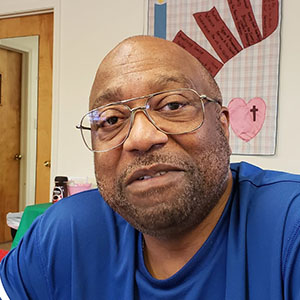
The Rev. Dr. James Capers – Missioner, Evangelist, Composer, Pastor

It took two interviews, a technological lesson  or two for the blogger to get this interview posted.  Yet Pastor Capers showed me the patience he gave to the people he served in multiple locations in the ELCA as a Lay Associate, Seminarian, Mission Developer, Staff Person, Composer, Collaborator and small town pastor in central Indiana…in retirement…Ha…….

A member of the Association of Lutheran Church Musicians (ELCM), Pr. Capers died on January 23, 2025 at the age of 76. He served as interim pastor at Salem Lutheran Church In Indianapolis, Indiana, from December 2016 until he joined the Church Triumphant on January 23, 2025.

From the obituary on the ALCM website: Pastor Capers is probably best known in Lutheran circles as the composer of setting II in This Far by Faith, an African American worship resource. Published in 1999 as a joint project of the ELCA and LCMS, This Far by Faith was conceived as a worship resource that would supplement the principal worship books in use at the time within those denominations as well as future resources that might be developed. In addition to composing setting II, Pastor Capers served on the project’s music subcommittee.

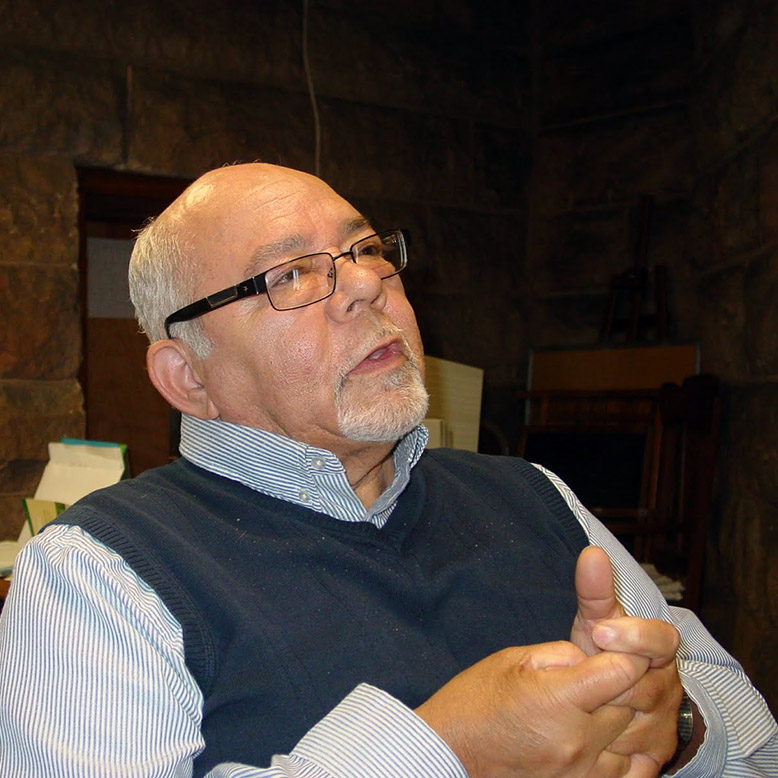
James Capers

Fred Allen

His pastor didn’t let him see his hearing loss as a disability but as an asset for his own education, and later as a vocational specialization in the church.  He was a part of the 100th Year Celebration for St.Philips, Philadelphia, and still serves in Stouchberg, PA.

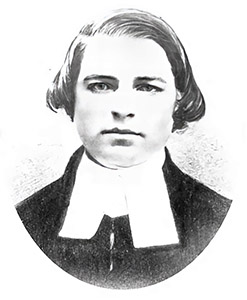
Johann Friederich Doescher called to be the missionary to Black [Colored] Missions

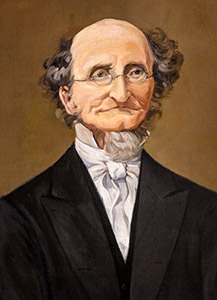
Johann Friederich Doescher

Johann Friederich Doescher photo from Our Iowa Heritage

October 1877, Johann Friederich Doescher was called to be the missionary to Black [Colored] Missions, based in Little Rock and traveling the southern tier: Tennessee, Georgia, Florida, Alabama, Mississippi, and Louisiana.  In his first year Doescher started a Sunday School in ‘Sailor’s Home’. After 2 years, he accepted a call to St. John Lutheran Church, New Orleans, with permission to continue work with the Sailors Home Mission. He was dismissed in January of 1882 because of mental illness (Some have suggested that Doescher had a falling out with then Synod president C.F.W. Walther, and Walther fabricated the charge of mental illness to have him removed), and then joined the Ohio Synod. Later, he served parishes of the Ohio Synod in Texas, Washington, and Meno, South Dakota. He died in November 1916 at the age of 78.

J. Friederich Doescher was born on July 15, 1840 in Loeste, Hannover, Germany and lived in Logansport, Indiana for some time. In 1859 he graduated from the Fort Wayne seminary and was ordained that same year in Iowa City, Iowa by the Rev. August Selle. On May 15, 1860, he married Adelheid Meyer and together they had five sons and six daughters.

Read more on Pontchartrain.net, which was the source for some of the information in this post.

Evangelical Lutheran Synodical Conference of North America formed

July 10, 1872 – The Synods of Ohio and Other States; Missouri, Ohio and Other States; Wisconsin; Norwegian Lutheran; Illinois; and Minnesota formed the Evangelical Lutheran Synodical Conference of North America to conduct conjointly a mission among the heathen, particularly a mission among the colored people of the country.

A detailed history of the Evangelical Lutheran Synodical Conference of North America can be found on Wikipedia.

First Saint Paul’s Lutheran Church – Birth of the Missouri Synod

First St. Paul's Chicago first churchSaxon immigrants established a new church in North America (the Lutheran Church Missouri Synod – LCMS), made up of 12 Pastors and 14 Congregations, meeting April 26, 1847 at First St. Paul’s Lutheran Church, Chicago.
A little history from the First St. Paul’s Lutheran Church website:

In the midst of a heavy blizzard in 1843, nine men and several women met at a grocery store on the corner of Franklin and Lake Streets to organize a congregation. Saint Paul was chosen as the name for the new congregation, and five men were asked to select and obtain a building lot.

The Missouri Synod was organized at First Saint Paul’s in the spring of 1847, and Pastor Selle of First St. Paul’s became a member. The place of worship was relocated to the courthouse at Clark and Randolph.

A new modest chapel was built on Grand Avenue, between Franklin and Wells Streets at the cost of $400, and dedicated on July 15, 1849.

CFW Walther settles in Perry County, Missouri

C. F. W. Walther

Reproduction photograph of the painting depicting C. F. W. Walther, made Tuesday, May 11, 2021, at the International Center of The Lutheran Church—Missouri Synod. LCMS Communications/Erik M. Lunsford

Emigrating from Saxony to Perry County, MO. CFW Walther at age 27 led Lutherans to settle in Perry County, Missouri.

About C.W.F. Walther

Carl Ferdinand Wilhelm Walther (1811-1886), called “Ferdinand” by his family and C.F.W. by the LCMS (Lutheran Church Missouri Synod) today, was born on Oct. 25, 1811, in Saxony, Germany. He was a pastor’s son and went on to become a pastor himself. He was studying theology at the University of Leipzig when, at 18 years old, he nearly died of an illness affecting his lungs. While he recuperated, he read through the works of Martin Luther with a vengeance. It was because of this experience that C.F.W. Walther became committed to confessional Lutheranism: believing and practicing as a Lutheran who holds to all of the writings contained in the 1580 Book of Concord.

By the time Walther was ordained at age 26 in 1837, his confessional Lutheranism was already becoming a bit of a problem. The Saxon government decided to take a cue from the larger and rapidly-growing Prussians, who 20 years earlier had enacted the Prussian Union, which merged the Lutheran and Reformed (Calvinist) churches in order to centralize the state church and consolidate power. Because Lutherans and the Reformed hold very different doctrines on major points like the Lord’s Supper, the result was that the Prussian state forced Lutherans to accommodate Calvinist teachings, which went against Lutheran confessional documents. This in turn led to state-sponsored persecution of so-called “Old Lutherans,” who defied the state by worshipping in secret.

Learn more about C.F.W. Walther in the LCMS The Lutheran Witness website. The above content is from the website.

A man named Emmanuel was baptized at Evangelical Lutheran Church of St. Matthew in New Amsterdam, Palm Sunday 1669

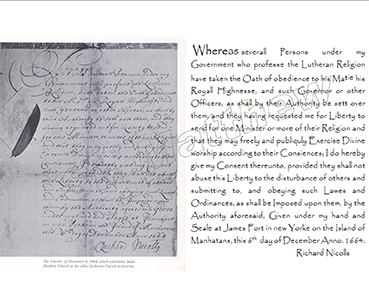
St. Matthews (NYC) original Charter

St. Matthews (NYC) original Charter

Historical records show that the first Lutheran baptism of an American of African descent occurred on Palm Sunday in 1669, when a man named Emmanuel was baptized at Evangelical Lutheran Church of St. Matthew in New Amsterdam (now New York City). The congregation was founded in 1643 by Dutch Lutherans in New Amsterdam but the church was not chartered until December 6, 1664, when the new governor, Richard Nicolls, issued a charter after the British had taken control of the colony in April 1664. America’s oldest Lutheran congregation, is now part of the LCMS.