Posts filed under: 16-17th Centuries

16-17th Centuries

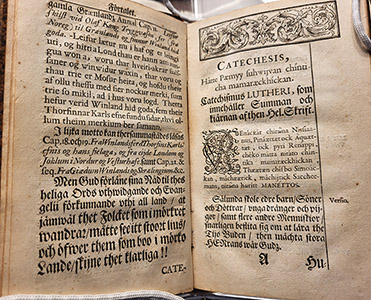
Luther’s Catechism translated into Lenape language 1696

Lutheran Catechism

Lutheran Catechism (utheri Catechismus ӧfwersatt på American-Virginiske språket) in the Library of Congress collection

Luther’s Kleiner Catechismus was translated into the Munsee language by Johan Campanius Holm on his arrival in New Sweden (Pennsylvania) in 1643. It was unprinted until 1696 due to the decline in mission work among the Indians.

Princeton University Library has a full copy from the publisher you can view here. Stockholm : Tryckt vthi thet af Kongl. Maytt. privileg. Burchardi tryckeri af J.J. Genath f., 1696

The Library of Congress also has a copy, and Meg Nicholas, Folklife Specialist at the American Folklife Center and a member of the Lenape tribe, details her search for materials related to the Lenape people at the Library of Congress. Her blog post “’Yet We Desire to Rejoice…in Our Own Language’: Munsee Religious Texts in the Library of Congress” tells of her finding of a copy of Lutheri Catechismus Ó§fwersatt pÃ¥ American-Virginiske sprÃ¥ket as part of her search.

A man named Emmanuel was baptized at Evangelical Lutheran Church of St. Matthew in New Amsterdam, Palm Sunday 1669

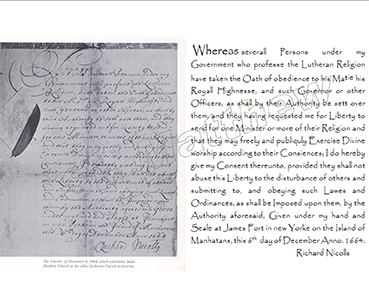
St. Matthews (NYC) original Charter

St. Matthews (NYC) original Charter

Historical records show that the first Lutheran baptism of an American of African descent occurred on Palm Sunday in 1669, when a man named Emmanuel was baptized at Evangelical Lutheran Church of St. Matthew in New Amsterdam (now New York City). The congregation was founded in 1643 by Dutch Lutherans in New Amsterdam but the church was not chartered until December 6, 1664, when the new governor, Richard Nicolls, issued a charter after the British had taken control of the colony in April 1664. America’s oldest Lutheran congregation, is now part of the LCMS.

Frederick Evangelical Lutheran Church established 1666

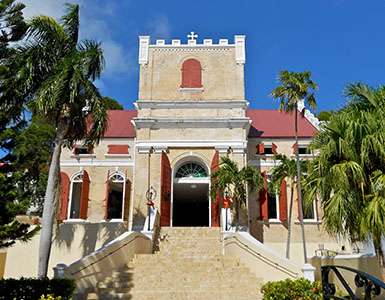
Frederick Evangelical Lutheran Church, St. Thomas, Virgin Islands

Frederick Evangelical Lutheran Church, St. Thomas, Virgin Islands

Frederick Evangelical Lutheran Church was established in 1666, the same year that Erik Nelson Smith took formal possession of the island of St. Thomas in the name of the Danish West Indies Company. The original colonizing group included a Lutheran pastor, Kjeld Jensen from Slagelse. A few months after the settlers landed, Smith died, and the Lutheran pastor had to assume temporal, as well as spiritual leadership. The Lutheran church, during the early decades of the Danish colony, was closely allied with the development of the colony. The settlement was a venture of private enterprise by the stockholders of the Danish West Indies Company under a charter by the royal government. This charter included a provision that the Lutheran church (the state religion of Denmark) was to be maintained in the colony and the company was to select appropriate ministers to serve.

When St. Thomas became a crown colony through the purchase of the company by the state in 1754, the church was able to expand its role in community affairs rapidly. It was already operating schools for the Lutheran children and it later did so for slave children as well. It was a Lutheran pastor, the Rev. Hans Stoud, who first proposed that a hospital and school should be built on each island and saw his proposal realized on St. Thomas.

With regard to slavery, which was the expected labor force of a plantation economy, the slaves owned by Frederick church for parsonage use were freed by decision of the church wardens in 1845, and all slaves who had had not heretofore purchased or earned their freedom were granted unconditional emancipation by Governor Peter van Scholten in 1848. A similar proclamation was issued by president Lincoln for the United States in 1863.

Learn more of the history of  Frederick Evangelical Lutheran Church on the church’s website.

John Campanus sent by Church of Sweden 1642

John Campanius was born Stockholm, Sweden, in 1601 and was educated there and at the University of Upsalla. He was ordained in 1633 and in 1642 was sent by Church of Sweden to North America as a missionary to Native Americans. Landing in Delaware on February 15, 1643,  became the first European settler. where he taught the local Algonquin Indians, and translated Luther’s Catechism into their language.

Learn more about Campanius here.

Martin Luther Dies

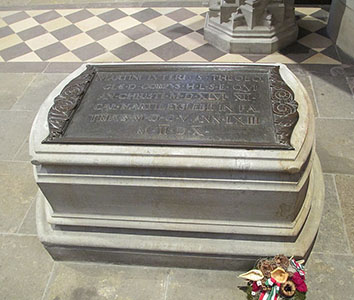
Martin Luther GraveMartin Luther died February 22, 1546. He was buried at All Saints’ Church, commonly known as the Castle Church (Schlosskirche) in Wittenberg, Germany. The church is the UNESCO World Heritage site where Martin Luther is believed to have posted his 95 Theses in 1517, launching the Protestant Reformation. Located in Saxony-Anhalt, this historical landmark serves as a major memorial site featuring the tombs of both Luther and Philipp Melanchthon.
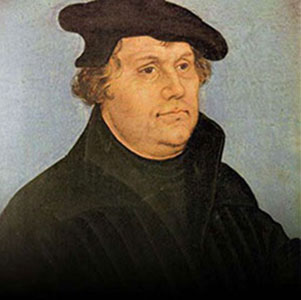
Image used under Wikimedia Creative Commons Attribution-Share Alike 4.0 International License. Copyright dr. avishai teicher 

Martin Luther posts his 95 Theses

Martin Luther

Martin Luther

According to one account, Luther nailed his Ninety-five Theses to the door of All Saints’ Church in Wittenberg on 31 October 1517. Scholars Walter Krämer, Götz Trenkler, Gerhard Ritter, and Gerhard Prause contend that the story of the posting on the door, although it has become one of the pillars of history, has little foundation in truth.[52][53][54][55] The story is based on comments made by Luther’s collaborator Philip Melanchthon, though it is thought that he was not in Wittenberg at the time.[56] According to Roland Bainton, on the other hand, it is true.[57]

The Latin Theses were printed in several locations in Germany in 1517. In January 1518 friends of Luther translated the Ninety-five Theses into German.[58] Within two weeks, copies of the theses had spread throughout Germany. Luther’s writings circulated widely, reaching France, England, and Italy as early as 1519. Students thronged to Wittenberg to hear Luther speak. He published a short commentary on Galatians and his Work on the Psalms. This early part of Luther’s career was one of his most creative and productive.[59] Three of his best-known works were published in 1520: To the Christian Nobility of the German Nation, On the Babylonian Captivity of the Church, and On the Freedom of a Christian.

from the ELCA Seminar My Theses: A History

Explore 7 Things You Might Like to Know about Martin Luther from Living Lutheran