Posts filed under: 19th Century

19th Century

Johann Friederich Doescher called to be the missionary to Black [Colored] Missions

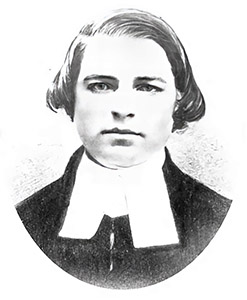
Johann Friederich Doescher

Johann Friederich Doescher photo from Our Iowa Heritage

October 1877, Johann Friederich Doescher was called to be the missionary to Black [Colored] Missions, based in Little Rock and traveling the southern tier: Tennessee, Georgia, Florida, Alabama, Mississippi, and Louisiana.  In his first year Doescher started a Sunday School in ‘Sailor’s Home’. After 2 years, he accepted a call to St. John Lutheran Church, New Orleans, with permission to continue work with the Sailors Home Mission. He was dismissed in January of 1882 because of mental illness (Some have suggested that Doescher had a falling out with then Synod president C.F.W. Walther, and Walther fabricated the charge of mental illness to have him removed), and then joined the Ohio Synod. Later, he served parishes of the Ohio Synod in Texas, Washington, and Meno, South Dakota. He died in November 1916 at the age of 78.

J. Friederich Doescher was born on July 15, 1840 in Loeste, Hannover, Germany and lived in Logansport, Indiana for some time. In 1859 he graduated from the Fort Wayne seminary and was ordained that same year in Iowa City, Iowa by the Rev. August Selle. On May 15, 1860, he married Adelheid Meyer and together they had five sons and six daughters.

Read more on Pontchartrain.net, which was the source for some of the information in this post.
Evangelical Lutheran Synodical Conference of North America formed

July 10, 1872 – The Synods of Ohio and Other States; Missouri, Ohio and Other States; Wisconsin; Norwegian Lutheran; Illinois; and Minnesota formed the Evangelical Lutheran Synodical Conference of North America to conduct conjointly a mission among the heathen, particularly a mission among the colored people of the country.

A detailed history of the Evangelical Lutheran Synodical Conference of North America can be found on Wikipedia.

First Saint Paul’s Lutheran Church – Birth of the Missouri Synod

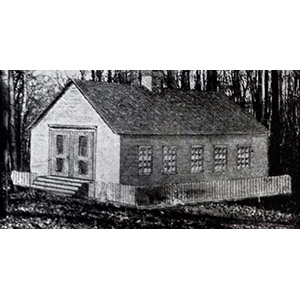
First St. Paul's Chicago first churchSaxon immigrants established a new church in North America (the Lutheran Church Missouri Synod – LCMS), made up of 12 Pastors and 14 Congregations, meeting April 26, 1847 at First St. Paul’s Lutheran Church, Chicago.
A little history from the First St. Paul’s Lutheran Church website:

In the midst of a heavy blizzard in 1843, nine men and several women met at a grocery store on the corner of Franklin and Lake Streets to organize a congregation. Saint Paul was chosen as the name for the new congregation, and five men were asked to select and obtain a building lot.

The Missouri Synod was organized at First Saint Paul’s in the spring of 1847, and Pastor Selle of First St. Paul’s became a member. The place of worship was relocated to the courthouse at Clark and Randolph.

A new modest chapel was built on Grand Avenue, between Franklin and Wells Streets at the cost of $400, and dedicated on July 15, 1849.

CFW Walther settles in Perry County, Missouri

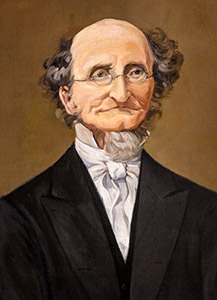
C. F. W. Walther

Reproduction photograph of the painting depicting C. F. W. Walther, made Tuesday, May 11, 2021, at the International Center of The Lutheran Church—Missouri Synod. LCMS Communications/Erik M. Lunsford

Emigrating from Saxony to Perry County, MO. CFW Walther at age 27 led Lutherans to settle in Perry County, Missouri.

About C.W.F. Walther

Carl Ferdinand Wilhelm Walther (1811-1886), called “Ferdinand” by his family and C.F.W. by the LCMS (Lutheran Church Missouri Synod) today, was born on Oct. 25, 1811, in Saxony, Germany. He was a pastor’s son and went on to become a pastor himself. He was studying theology at the University of Leipzig when, at 18 years old, he nearly died of an illness affecting his lungs. While he recuperated, he read through the works of Martin Luther with a vengeance. It was because of this experience that C.F.W. Walther became committed to confessional Lutheranism: believing and practicing as a Lutheran who holds to all of the writings contained in the 1580 Book of Concord.

By the time Walther was ordained at age 26 in 1837, his confessional Lutheranism was already becoming a bit of a problem. The Saxon government decided to take a cue from the larger and rapidly-growing Prussians, who 20 years earlier had enacted the Prussian Union, which merged the Lutheran and Reformed (Calvinist) churches in order to centralize the state church and consolidate power. Because Lutherans and the Reformed hold very different doctrines on major points like the Lord’s Supper, the result was that the Prussian state forced Lutherans to accommodate Calvinist teachings, which went against Lutheran confessional documents. This in turn led to state-sponsored persecution of so-called “Old Lutherans,” who defied the state by worshipping in secret.

Learn more about C.F.W. Walther in the LCMS The Lutheran Witness website. The above content is from the website.

John Bachman (1790-1874) Part 2: in the 1800s

John Bachman

John Bachman

John Bachman (February 4, 1790 – February 24, 1874) grew up in upstate NY, educated via his curiosity on nature and the Bible nurtured by his pastors. He was an American Lutheran minister, social activist and naturalist who collaborated with John James Audubon to produce Viviparous Quadrupeds of North America and whose writings, particularly Unity of the Human Race, were influential in the development of the theory of evolution. He was married to the painter Maria Martin. Several species of animals are named in his honor.

Bachman served the same Charleston, South Carolina church as pastor for 56 years but still found time to conduct natural history studies that caught the attention of noted bird artist John James Audubon and eminent scientists in England, Europe, and beyond. He was a proponent of secular and religious education and helped found Newberry College and the Lutheran Theological Southern Seminary, as well as the South Carolina Lutheran Synod.

He was elected an Associate Fellow of the American Academy of Arts and Sciences in 1845.

Bachman was a social reformer who ministered to African-American slaves as well as white Southerners, and who used his knowledge of natural history to become one of the first writers to argue scientifically that blacks and whites are the same species. His accomplishments span a lifetime punctuated by the unrest of the American Civil War—a conflict that caused him great consternation and may have brought about his premature death due to injuries suffered at the hands of Union soldiers.

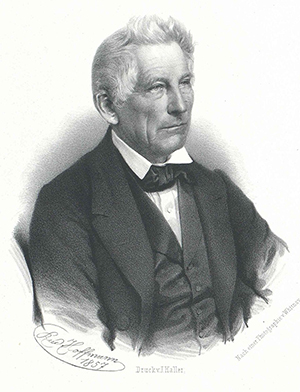
John Bachman image by J. Haller,  Österreichische Nationalbibliothek, Public Domain

Notable dates and influences of John Bachman:

1802 – At age 12, moved to Philadelphia to continue his education with John Bartram, which built upon his wilderness travels in Upstate New York science and religion were both of interest. With his Philadelphia pastoral mentor at St. John’s Lutheran Church, he tutored/taught to subsidized his own educational endeavors. Bachman lifted and mentored a number of Black Lutherans in ministry in the 1800s. See them in this timeline entry.

1806 – Worked with John Bartram and co-wrote 2 books with John Audubon.

1813 – First call as Pastor at Gilead – Center Brunswick, Zion – West Sandlake, and his home parish St. John – Schaghticoke, all in Upstate New York.

1815 – January 14, Bachman would begin a ministry at St. John Lutheran Church, Charleston, SC, that would end in 1871 with his poor health.

1820* – Bachman was called to St. John, Charleston South Carolina, He receives permission to invite Negroes to worship at St. John, and by 1825 there are 37 Negro members. By 1825 there are 97 communing members, By 1845 – 200 Black members. By 1860 the Negro Sunday School had 32 teachers and 150 Students. As synod Bishop in 1862 – 255 of all Lutherans in South Carolina were people of color.

1832* – Bachman sends Jehu Jones, a freedman, to the New York Ministerium to be ordained for service in Liberia, caught in South Carolina laws that forbid freeman returning, returned north. Rejected for service in Liberia because of age, he was directed to mission work in Philadelphia. Purchased property on Quince Street, Philadelphia, for St. Paul’s Evangelical Lutheran Church, where the cornerstone was laid in 1834.

1835* – Daniel Payne, a freedman, was restricted by law from teaching in South Carolina, leaves with letters of recommendation from Charleston leaders including John Bachman. Contacts, references and notes show his unwillingness to mission work in Africa. His desire is to teach. The Evangelical Lutheran Society of Inquiry on Missions sought to support a person of color to study theology at their school preparatory to ministry in the Lutheran Church. After careful study of Schmucker‘s advocacy for injustice in America, he accepted the invitation. Payne was ordained May 24, 1837 by the Franckean Synod, the only American Lutheran Body to speak out consistently against slavery.

1845* – Boston J. Drayton, a member of St. John’s, Charleston applied for permission to go to Africa as a missionary. Bachman, as Synod President [Bishop] gave Drayton credentials for his missionary work, as the ship to Maryland [Liberia] was leaving prior to the Synod Meeting.

1868* – Michael Coble [Cobb?] was licensed to preach by the North Carolina Synod.

1880* – D.J. Koontz ordained by the General Synod.

1884* – Nathan Clapp and Samuel Holt were ordained by the North Carolina Synod, but not granted full pastoral privileges nor financial support.

1888* – William Philo Phifer, educated in Baltimore and licensed by the Maryland Synod 10/4/1888 was received by North Carolina Synod 8/28/1889 and ordained 4/2/1890. St. Paul’s organized St. Paul’s Lutheran Church and school.

1889* – Coble, Koontz, Clapp and Holt, not receiving support from the North Carolina Synod, formed The Alpha Synod of the Evangelical Lutheran Church of Freedmen in America.

1890 – Koontz dies.

1891 – In seeking funds for support, the Synodical Conference sends Nils J. Bakke to supervise.