Posts tagged with: Walther

Walther

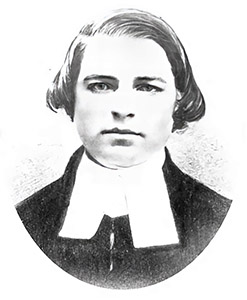
Johann Friederich Doescher called to be the missionary to Black [Colored] Missions

Johann Friederich Doescher

Johann Friederich Doescher photo from Our Iowa Heritage

October 1877, Johann Friederich Doescher was called to be the missionary to Black [Colored] Missions, based in Little Rock and traveling the southern tier: Tennessee, Georgia, Florida, Alabama, Mississippi, and Louisiana.  In his first year Doescher started a Sunday School in ‘Sailor’s Home’. After 2 years, he accepted a call to St. John Lutheran Church, New Orleans, with permission to continue work with the Sailors Home Mission. He was dismissed in January of 1882 because of mental illness (Some have suggested that Doescher had a falling out with then Synod president C.F.W. Walther, and Walther fabricated the charge of mental illness to have him removed), and then joined the Ohio Synod. Later, he served parishes of the Ohio Synod in Texas, Washington, and Meno, South Dakota. He died in November 1916 at the age of 78.

J. Friederich Doescher was born on July 15, 1840 in Loeste, Hannover, Germany and lived in Logansport, Indiana for some time. In 1859 he graduated from the Fort Wayne seminary and was ordained that same year in Iowa City, Iowa by the Rev. August Selle. On May 15, 1860, he married Adelheid Meyer and together they had five sons and six daughters.

Read more on Pontchartrain.net, which was the source for some of the information in this post.
CFW Walther settles in Perry County, Missouri

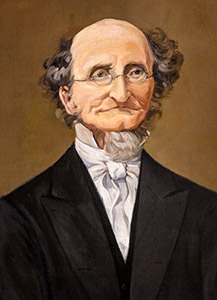
C. F. W. Walther

Reproduction photograph of the painting depicting C. F. W. Walther, made Tuesday, May 11, 2021, at the International Center of The Lutheran Church—Missouri Synod. LCMS Communications/Erik M. Lunsford

Emigrating from Saxony to Perry County, MO. CFW Walther at age 27 led Lutherans to settle in Perry County, Missouri.

About C.W.F. Walther

Carl Ferdinand Wilhelm Walther (1811-1886), called “Ferdinand” by his family and C.F.W. by the LCMS (Lutheran Church Missouri Synod) today, was born on Oct. 25, 1811, in Saxony, Germany. He was a pastor’s son and went on to become a pastor himself. He was studying theology at the University of Leipzig when, at 18 years old, he nearly died of an illness affecting his lungs. While he recuperated, he read through the works of Martin Luther with a vengeance. It was because of this experience that C.F.W. Walther became committed to confessional Lutheranism: believing and practicing as a Lutheran who holds to all of the writings contained in the 1580 Book of Concord.

By the time Walther was ordained at age 26 in 1837, his confessional Lutheranism was already becoming a bit of a problem. The Saxon government decided to take a cue from the larger and rapidly-growing Prussians, who 20 years earlier had enacted the Prussian Union, which merged the Lutheran and Reformed (Calvinist) churches in order to centralize the state church and consolidate power. Because Lutherans and the Reformed hold very different doctrines on major points like the Lord’s Supper, the result was that the Prussian state forced Lutherans to accommodate Calvinist teachings, which went against Lutheran confessional documents. This in turn led to state-sponsored persecution of so-called “Old Lutherans,” who defied the state by worshipping in secret.

Learn more about C.F.W. Walther in the LCMS The Lutheran Witness website. The above content is from the website.