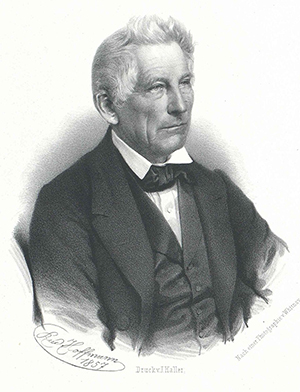
John Bachman (1790-1874) Part 2: in the 1800s

John Bachman
John Bachman (February 4, 1790 – February 24, 1874) grew up in upstate NY, educated via his curiosity on nature and the Bible nurtured by his pastors. He was an American Lutheran minister, social activist and naturalist who collaborated with John James Audubon to produce Viviparous Quadrupeds of North America and whose writings, particularly Unity of the Human Race, were influential in the development of the theory of evolution. He was married to the painter Maria Martin. Several species of animals are named in his honor.
Bachman served the same Charleston, South Carolina church as pastor for 56 years but still found time to conduct natural history studies that caught the attention of noted bird artist John James Audubon and eminent scientists in England, Europe, and beyond. He was a proponent of secular and religious education and helped found Newberry College and the Lutheran Theological Southern Seminary, as well as the South Carolina Lutheran Synod.
He was elected an Associate Fellow of the American Academy of Arts and Sciences in 1845.
Bachman was a social reformer who ministered to African-American slaves as well as white Southerners, and who used his knowledge of natural history to become one of the first writers to argue scientifically that blacks and whites are the same species. His accomplishments span a lifetime punctuated by the unrest of the American Civil War—a conflict that caused him great consternation and may have brought about his premature death due to injuries suffered at the hands of Union soldiers.
John Bachman image by J. Haller, Österreichische Nationalbibliothek, Public Domain
Notable dates and influences of John Bachman:
1802 – At age 12, moved to Philadelphia to continue his education with John Bartram, which built upon his wilderness travels in Upstate New York science and religion were both of interest. With his Philadelphia pastoral mentor at St. John’s Lutheran Church, he tutored/taught to subsidized his own educational endeavors. Bachman lifted and mentored a number of Black Lutherans in ministry in the 1800s. See them in this timeline entry.
1806 – Worked with John Bartram and co-wrote 2 books with John Audubon.
1813 – First call as Pastor at Gilead – Center Brunswick, Zion – West Sandlake, and his home parish St. John – Schaghticoke, all in Upstate New York.
1815 – January 14, Bachman would begin a ministry at St. John Lutheran Church, Charleston, SC, that would end in 1871 with his poor health.
1820* – Bachman was called to St. John, Charleston South Carolina, He receives permission to invite Negroes to worship at St. John, and by 1825 there are 37 Negro members. By 1825 there are 97 communing members, By 1845 – 200 Black members. By 1860 the Negro Sunday School had 32 teachers and 150 Students. As synod Bishop in 1862 – 255 of all Lutherans in South Carolina were people of color.
1832* – Bachman sends Jehu Jones, a freedman, to the New York Ministerium to be ordained for service in Liberia, caught in South Carolina laws that forbid freeman returning, returned north. Rejected for service in Liberia because of age, he was directed to mission work in Philadelphia. Purchased property on Quince Street, Philadelphia, for St. Paul’s Evangelical Lutheran Church, where the cornerstone was laid in 1834.
1835* – Daniel Payne, a freedman, was restricted by law from teaching in South Carolina, leaves with letters of recommendation from Charleston leaders including John Bachman. Contacts, references and notes show his unwillingness to mission work in Africa. His desire is to teach. The Evangelical Lutheran Society of Inquiry on Missions sought to support a person of color to study theology at their school preparatory to ministry in the Lutheran Church. After careful study of Schmucker‘s advocacy for injustice in America, he accepted the invitation. Payne was ordained May 24, 1837 by the Franckean Synod, the only American Lutheran Body to speak out consistently against slavery.
1845* – Boston J. Drayton, a member of St. John’s, Charleston applied for permission to go to Africa as a missionary. Bachman, as Synod President [Bishop] gave Drayton credentials for his missionary work, as the ship to Maryland [Liberia] was leaving prior to the Synod Meeting.
1868* – Michael Coble [Cobb?] was licensed to preach by the North Carolina Synod.
1880* – D.J. Koontz ordained by the General Synod.
1884* – Nathan Clapp and Samuel Holt were ordained by the North Carolina Synod, but not granted full pastoral privileges nor financial support.
1888* – William Philo Phifer, educated in Baltimore and licensed by the Maryland Synod 10/4/1888 was received by North Carolina Synod 8/28/1889 and ordained 4/2/1890. St. Paul’s organized St. Paul’s Lutheran Church and school.
1889* – Coble, Koontz, Clapp and Holt, not receiving support from the North Carolina Synod, formed The Alpha Synod of the Evangelical Lutheran Church of Freedmen in America.
1890 – Koontz dies.
1891 – In seeking funds for support, the Synodical Conference sends Nils J. Bakke to supervise.