Posts filed under: 18th Century

18th Century

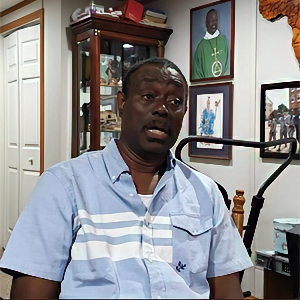
Rev. Dr. Emanuel Grantson is the first person I know who was knowledgeable of the life, education, and history of service to the Church of Anton Anselm Amo

Dr. Enamuel Grantson

The Rev. Dr. Emanuel F.Y. Grantson is the first person I know who was knowledgeable of the life, education, and history of service to the Church of Anton Anselm Amo.

While Dr. Grantson has served in his native Ghana; Christ, Philadelphia; St. Michaels Truth Lutheran Church, Mitchelleville, MD; as well as taught at the seminary level. He continues to have a heart for the people he services. We shared impressions of the church’s work among people of color and with African nationals. Our collective knowledge of Anton Anselm Amo kept our conversation going.

Anton Anselm Amo, a Ghanaian, in the early 1700’s was taken to Germany, where he was a companion to the children of Duke Anton Ulrich Brunswick- Wolfenbüttel, and sons Wilhelm August and Ludwig Rudolp. In this home, Amo was influenced by Augustus Hermann Francke and Gottfried Wilhelm von Leibniz.

Learn more about Anton Amo.

John Bachman (1790-1874) – Part 1 through the first decade of Bachman’s life

John Bachman

John Bachman

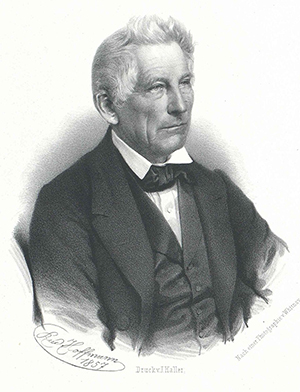
John Bachman (February 4, 1790 – February 24, 1874) grew up in upstate NY, educated via his curiosity on nature and the Bible nurtured by his pastors. He was an American Lutheran minister, social activist and naturalist who collaborated with John James Audubon to produce Viviparous Quadrupeds of North America and whose writings, particularly Unity of the Human Race, were influential in the development of the theory of evolution. He was married to the painter Maria Martin. Several species of animals are named in his honor.

Bachman served the same Charleston, South Carolina church as pastor for 56 years but still found time to conduct natural history studies that caught the attention of noted bird artist John James Audubon and eminent scientists in England, Europe, and beyond. He was a proponent of secular and religious education and helped found Newberry College and the Lutheran Theological Southern Seminary, as well as the South Carolina Lutheran Synod.

He was elected an Associate Fellow of the American Academy of Arts and Sciences in 1845.

Bachman was a social reformer who ministered to African-American slaves as well as white Southerners, and who used his knowledge of natural history to become one of the first writers to argue scientifically that blacks and whites are the same species. His accomplishments span a lifetime punctuated by the unrest of the American Civil War—a conflict that caused him great consternation and may have brought about his premature death due to injuries suffered at the hands of Union soldiers.

John Bachman image by J. Haller,  Österreichische Nationalbibliothek, Public Domain

Notable dates and influences of John Bachman:

1796 – John C. Hartwick’s will provides land purchased from the Mohawks for “a school of theology for the propagation of the Evangelical Christian Religion among the heathen.”
– Hartwick College. Bachman’s Pastor, Frederick Henry Quitman, graduated Halle, served in Curacao for 12 years, then became the theological presence to train students at Hartwick.

Henry Melchior Muhlenberg (1711-1787)

f Henry Melchior Muhlenberg, Preservation Society of Newport County

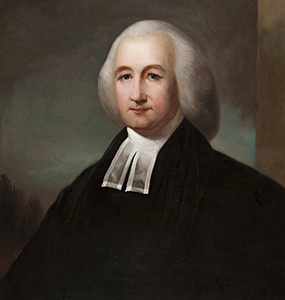
Henry Melchior Muhlenberg, Preservation Society of Newport County

Henry Melchoir Muhlenberg, often known as “the father of American Lutheranism, was a prominent American Lutheran pioneer pastor, church planter, organizer, administrator, liturgist and chronicler. Sent by Halle Pietists in 1742 to counter Moravian incursions among German Lutherans in Pennsylvania, Muhlenberg succeeded in quickening and galvanizing Lutheran self-consciousness and uniting communities into a synod by codifying religious practices during his 45 years of service.

Born in Einbeck, Germany, Muhlenberg was educated at Göttingen University, where he experienced a personal religious awakening. During a brief teaching tenure at the Francke Foundation in Halle, he became an ardent pietist, aspiring to go as a missionary to India. He was ordained in 1739 and served as assistant minister and director of the orphanage at Grosshennersdorf from 1739 to 1741, before he accepted the call to go to Pennsylvania.

During his brief visit to the Salzburgers in Savannah, Ga., in 1742, he was greatly disturbed by the practice of slavery and commented: “This is a terrible state of affairs, which will entail a severe judgment” (The Journals of Henry Melchior Muhlenberg, Vol. 1). Later in Philadelphia, he baptized African slaves and refused to take a slave given to him, but he implemented no measures to abolish this inhumane practice. The detailed journal he kept is a prodigious source of information about early U.S. Lutheranism.

After arriving in Philadelphia on Nov. 25, 1742, and confirming his call in the congregations he was to serve, he focused on dealing with the vagabond preachers who had arrived in Pennsylvania, especially Count Nikolaus von Zinzendorf, who was striving to form a pan-German Protestant church. Muhlenberg forced Zinzendorf to relinquish his hold on the Lutheran congregations in Philadelphia.

In his travels with father-in-law, an Indian Agent, Muhlenberg often baptized Blacks and Indians.

Read this exploration of Muhlenberg and his impact on the church in this Deeper Understanding from Living Lutheran.
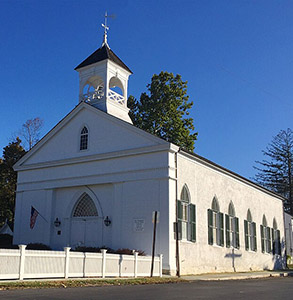
Lord God of Sabaoth Lutheran Church, Christiansted, St. Croix

Lord God of Sabaoth Lutheran Church

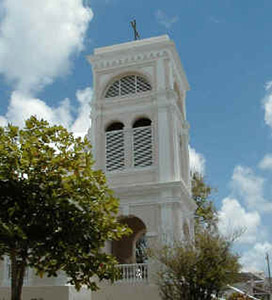
Lord God of Sabaoth Lutheran Church – current building

The Danish Lutheran Congregation held its first worship service in September 1734 in a small room at Fort Christianværn in Christiansted. It is the oldest church in St. Croix.

Construction of a permanent church home began in 1750 at a site located across from the present post office in Christiansted, now known as the Steeple Building. This new location was consecrated on 27 May 1753 as the Lutheran Church of the Zebaoth (meaning Church of the Lord of Hosts). Worship services were conducted at this site for 78 years.

More information on the congregation’s history including select gravesites can be found here.

Learn more about the Lutheran congregations in this story in Living Lutheran, An Ancient ELCA Church in the U.S.Virgin Islands.

Nazareth Lutheran Church St. John

Nazareth Lutheran Church St. John USVI

Nazareth Lutheran Church St. John USVI

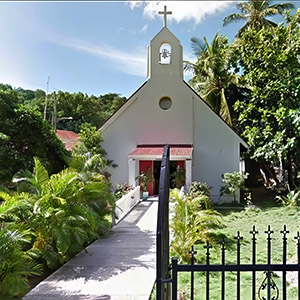
Nazareth Lutheran Church St. John, Virgin Islands, started as an outpost congregation linked to St. Thomas.

Nazareth is a congregation of the ELCA. The image is of the current church.

Learn more about the Lutheran congregations in this story in Living Lutheran, An Ancient ELCA Church in the U.S.Virgin Islands.

Also notable in the 1720s:

1725 – William C. Berkenmeyer, Graduate of Hamburg, replaces Jacob Fabritius, as Pastor in NYC, Albany and NJ, Slave Owner. Inserted in the church constitution, 1735, “that baptism does not ‘dissolve the tie of obedience.’”

Aree Van Guinea

Zion, Oldwick Lutheran Church

Zion, Oldwick Lutheran Church. This is the original church, built on land deeded by Arre Van Guinea

Aree Van Guinea, born in Dutch Guyana, captured and sold by slave hunters in New York City. By 1705 he and his wife were members of the Lutheran Church in New York. Gaining freedom for himself and his family, he was living in the Raritan Valley, NJ as early as 1708. Known as a property owner, but because of a laws prohibiting ownership of property by slaves, the deed was not placed in his name until 16 years later. A faithful Christian, Zion, Oldwick, New Jersey’s first service was held in his home attended by his neighbors, newly arrived Palatine Germans on July 1, 1714. Worship was led by Justus Falckner from Van Guinea’s congregation in NYC.

Van Guinea deeded a portion of his property to build the first church there, which still stands on a corner in Oldwick.

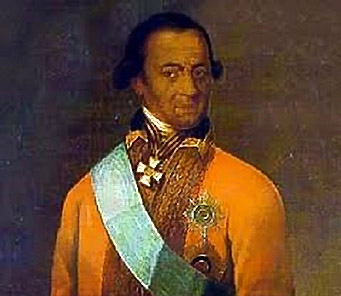
Anton Wilhelm Amo

Anton Wilhelm Almo

Anton Wilhelm Almo

Anton Wilhelm Amo was born in 1703 in Axim in the western region of present-day Ghana. In 1707 he was taken by the Dutch West India Company to Amsterdam and given as a “present” to German Duke Anton Ulrich of Brunswick-Wolfenbüttel and sons Wilhelm August and Ludwig Rudolp, and treated as a member of the family and educated as such. Amo influenced by Augustus Hermann Francke and Gottfried Wilhelm von Leibniz. Amo was the first African-born person known to have attended a European university. He responded to the heavy influence in the teaching and the ministry that flowed from Halle University. Liebniz is reported to have been a house guest at the home of nton Ulrich von Wolfenbuttel. Anton Amo was sometimes called a disciple of Liebniz.

1729 JD, University of Halle, 1730 M.Phil, University of Wittenberg, 1734 D.Phil., University of Wittenberg, 1735-39 Professor, University of Halle, 1740-46 Professor, University of Jena.

You can read more about Anton Amo in the African American Registry and Ghana Web. Image from Ghana Web.

Rev. Dr. Emanuel Grantson talks about Anton Anselm Amo.