The Rev. Dr. James R. Thomas
Dr. James R. Thomas, retired Associate Professor of Church and Ministry at Lutheran Theological Southern Seminary, ordained minister in the Evangelical Lutheran Church in America (ELCA), longtime parish pastor and synod leader, and distinguished author. His book, A Rumor of Black Lutherans: The Formation of Black Leadership in Early American Lutheranism, brings long-overdue attention to an often overlooked chapter of American church history.
In an interview with Shepherd of the Hills Lutheran Church, Thomas reflected on the origins of the book, recalling, “I’ve heard rumors of Black Lutherans,” and explaining that while many within Lutheran circles were aware of their existence, the stories, leadership, and influence of Black Lutherans had largely gone undocumented.
According to Apple Books, A Rumor of Black Lutherans examines “the presence and contributions of Black Lutherans in the United States, a story that has historically received little attention in mainstream accounts of American Lutheranism.” The book traces the lives of ten notable African Americans connected to Lutheran churches, exploring their relationships with Lutheran communities and their significant roles in ministry, education, and service. Spanning multiple eras and regions, these biographical portraits offer a fuller and more accurate picture of Black leadership within the Lutheran tradition.
Through these narratives, Thomas highlights how Lutheran institutions supported African Americans—particularly through higher education and church leadership—and demonstrates how these contributions shaped both Lutheran history and the broader African American religious experience.
Michigan Lutheran College (The Invisible Black Lutheran College)
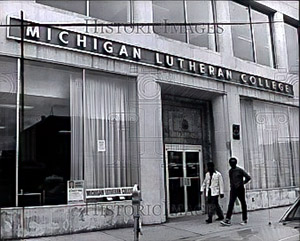
Michigan Lutheran College – 1969 press photo Michigan Lutheran College, Detroit (historicimages)
Lutherans established Michigan Lutheran College in February 1962 in Detroit, Michigan. The Michigan District of The Lutheran Church-Missouri Synod accepted the school on August 28, 1963, as the predecessor to the National Academy of Arts and Sciences, which was renamed Great Lakes College in 1936. “It became known that Great Lakes College, a non-profit corporation owned and operated by the C. J. Ettinger family in 1936, was either going to close its doors or was available to anyone interested in operating a college.”[i] Dr. Clayton Ettinger, a founder of the college, was interested in donating the school to a religious organization as a gift. A group of Lutherans led by Dr. John Choitz, Superintendent of the Lutheran High School Association of Greater Detroit, was selected to receive the college pending its formal acceptance by the Michigan District of The Lutheran Church-Missouri Synod. Choitz had expressed interest in providing collegiate options for Lutheran students in the urban Detroit area. Parker Palmer and Elden Jacobson noted, “That MLC came into being at all is an interesting testament to the extraordinary hope and optimism that continue to motivate some few among us.”
Given that a new Lutheran Church, Missouri Synod-related college, Concordia College, was opened 48 miles from Detroit on September 30, 1963, in Ann Arbor, Michigan, it is difficult to see how Missouri Synod Lutherans would support two educational franchises in the same geographical area with opening dates a year apart. Yet, the Michigan District of the Lutheran Church Missouri Synod permitted Dr. Choitz to open the college. Meetings were held with officials from the Michigan Department of Education and leaders in education throughout the state. The Executive Director of the Board of Higher Education of The Lutheran Church- Missouri Synod was also consulted by the Michigan District. The consensus was that the movement toward developing the college should continue. The Michigan District selected an interim Board of Directors and recruited faculty. The faculty included the Rev. Albert Pero, Jr., Pastor of Berea Lutheran Church, Detroit – an appointment that marked the inception of his long and distinguished career as a teaching theologian. In September 1962, Michigan Lutheran College held evening classes in two Lutheran High Schools. Dr. Choitz assumed the office of president on July 1, 1967. Parker J. Palmer, Author of The Company of Strangers: Christians and the Renewal of America’s Public Life, and Elden Jacobson offer this observation on the College’s origin and subsequent history.
MLC was, for example, Lutheran only indirectly. During 1963-69, most written documents spoke of the institution as owned by the Michigan District of the Lutheran Church-Missouri Synod, or, as the December 1963 report to the District, phrases the matter. This is the first time within the modern era of the Lutheran Church-Missouri Synod that a District has been willing to sponsor, own, and direct an institution of higher education.
But that phraseology and its suggested legalism easily obscure the more central issue: In its inception, the College was expected to incur no financial liability for which the District might be held accountable. As the charter’s recipient, the District provided non-profit, tax-exempt sponsorship—itself essential—but it did so only because Choitz believed, and so convinced the District’s governing boards that such a college could be largely self-sufficient on tuition alone.[ii]
Practically speaking, Michigan Lutheran College’s dependence on tuition was an early indicator that the school would not be around for long. Most colleges benefit from outside aid, either from religious organizations, alums, philanthropists, or state and federal funding. Choitz demonstrated skill as an administrator, leading the school for six years without operating deficits. Choitz believed that an expanding enrollment would attract sufficient funding and make possible accreditation.A vision of a fresh new approach for Lutherans in Higher Education drove John Choitz. The view that a Lutheran Christian college in inner-city Detroit was a wake-up call to a bold, innovative adventure. A looming problem at the commencement of this project was identifying a constituency. How and with whom this new school would engage would contribute to its identity and, consequently, the ability to implement a plan. The school, while branded Michigan Lutheran, was Lutheran in name only. The Michigan District of the Lutheran Church-Missouri Synod did not provide financial support for the school. Nor did the District assist in the recruitment of Lutheran high school students. With a new college in Ann Arbor, it is not surprising why. The college was in no position to recruit a Lutheran constituency. In 1967, when the school moved to Woodward Avenue, a predominantly black community, Lutherans constituted less than one-fourth of the total student body, and the school’s racial composition had approached White and Black parity.
Another critical question: What was the purpose of Michigan Lutheran College? Choitz proposed a place for Christian nurture. “…we intend always to offer truth in Christian terms,” or “The church has something to say to the civic man. The best place to say it is in the classroom while he is receiving training.”[iii] Choitz aimed at a faith-based education where students learned at the intersection of faith and reason. Choitz sifted his proposal through his vast knowledge of Martin Luther’s work and the subsequent history of Lutheran theological thought. A rich and often compelling vision, yes. It resembles pages of most liberal arts colleges’ catalogs.
While Choitz intended a place of Christian nurture, reviewing the college’s catalogs reveals a heavy emphasis on vocational training, especially in “medical assistants” and medical technology programs. This emphasis would fit with the building’s original design and purpose. There was also a strong overlay of “Religion” studies, including biblical studies, moral philosophy, and Lutheran doctrine.
We return to the previous question. What was the purpose of Michigan Lutheran College? While pronounced usage of heavy religious and traditional liberal arts imagery was present, in conjunction with very standard course offerings and vocational emphases, who constituted the potential constituency? Outside the world of Lutheranism, who? Choitz’s genuine hope of extending higher education to those without accessibility was evident in the school’s first catalog: “those not qualified by certificate may be admitted by entrance requirement.”[iv] In a publicity document written by Choitz and released in late 1967 following Detroit’s racial violence, a clearer picture of the identity dilemma of the school is sketched out:
We are an inner-city college, dedicated to meeting the tremendous social, religious, and educational needs of all the people of the city. We have Negroes and Whites, Lutherans, Baptists, Episcopalians, Presbyterians, Catholics, and Jews harmoniously welded together into a student body.
The inner-city student concerns the college… If they have the potential, Michigan Lutheran College tries to furnish the answer.[v]
The issue of “who” was the intended contingency was rendered moot when the school moved to Woodward Avenue in 1965. The student population primarily consisted of black “inner-city students” from Detroit, for whom some form of higher learning was often not attainable. However, the enrollment of student Sterling Garrison Belcher demonstrates that Michigan Lutheran College extended its recruitment efforts beyond Detroit. Belcher, a distinguished alumnus, hailed from Tulsa, Oklahoma, where he graduated from Booker T. Washington High School in 1966. Belcher, in many respects, represented the very image of what the school had the capacity to become, but never fully achieved. He was a reminder of the school’s unrealized possibilities. At the age of 18, Sterling took on a leadership role during the Civil Rights Movement as President of the Youth Chapter of the NAACP in Tulsa. During this time, he was also Vice President of the Congress of Racial Equality in Tulsa, OK., where he was one of the first persons in the local area to participate in “sit-ins” to break racial barriers. Sterling devoted much of his life to helping and advocating for others. He loved being in the presence of children and had a strong passion for helping youth. Following studies at Michigan Lutheran, he earned a Master of Divinity Degree from Concordia Seminary in Exile (SEMINEX), St. Louis, Missouri. He was the Founder and Director of the Black Leadership Training Program, which provided jobs for high school students in the St. Louis area, allowing them to receive proper business training and prepare for further education. He won grants from the Wheatridge Foundation and local St. Louis charities to finance his programs. He also organized Young Eternal Souls (Y.E.S.) in St. Louis, Missouri, which focused on getting children off the streets of St. Louis. Y.E.S. was an eighty-voice gospel choir, dance group, and theatrical group that traveled and performed in the St. Louis area and surrounding states. Children from all walks of life were inspired and led to positive outlets and a strong educational foundation.
In early 1980, Sterling returned to Tulsa, wondering why they had not claimed Martin Luther King’s Birthday as a national holiday. After meeting resistance from the city of Tulsa’s Parade Permit Department, he was denied an MLK Parade Permit for a couple of years, but that did not deter him from repeating the application process.
He was not granted a Parade Permit until national pressure from other states led to the commemoration of Rev. Dr. King’s birthday as a national holiday. With the Tulsa community’s pressure, our city not only granted the National Holiday status but also allowed the Parade Permit.
After obtaining the Parade Permit, black Tulsans began organizing efforts in 1984, starting with a small group of unified churches and pastors marching from north Tulsa to the Archer and then the Cincinnati bridge. That was the very first organizational march, without the parade amenities it has today – it took place in 1986.
Sterling Garrison Belcher, Jr. struggled with mental health issues during his short life. His life sadly ended on January 6, 2011, at a mental hospital in the Bronx at the age of 62. Sterling’s family provided a memorial service at The Lutheran Church of The Prince of Peace in Tulsa. Sterling Belcher embodied the possibilities Michigan Lutheran College aspired to, while also revealing how much of that potential went unrealized.
In a report to the Michigan District of the Lutheran Church Missouri-Synod, The Rev. Edward A. Westcott noted: “…the college was fulfilling a real and almost desperate need for the young people of central city Detroit. Our church had every reason to be proud that it had the courage to undertake this venture…”[vi]
The school was taken over by Shaw University of Raleigh, North Carolina, in 1970 and renamed Shaw College of Detroit. “Shaw College assumed at least $1 million of the debts of Michigan Lutheran College, including some back salaries for teachers, which were not cleared up until September 1976.”[vii] Shaw University, Raleigh, North Carolina, was led by Dr. King Cheek, brother of Dr. James Cheek, a 1950 graduate of Immanuel Lutheran College in Greensboro, NC, and the President of Howard University in Washington, D.C.
Victor Hugo observed: “You can resist an invading army; you cannot resist an idea whose time has come. Hugo also said, “An idea before its time must wait, for no one is crazy enough to grasp it…at the moment. And an idea whose time has passed must hope, for a future in which it will be needed again.” Michigan Lutheran College was an idea like that. The school was a venture into the central city by more than well-meaning Lutherans. It changed the lives of all too few residents of urban Detroit in its short life. It was the church in mission. And, it would seem, it mattered.
[i] Edward A. Westcott, Jr. Report on Michigan Lutheran College. August 1970. Concordia Historical Institute, Clayton, Mo. MLC_Shaw_University_MI_District_Convention_1970.pdf.
[ii] Ibid. 20-21.
[iii] Ibid. 21
[iv] Ibid. 22
[v] Ibid. 22
[vi] Westcott.
[vii] National Labor Relations Board Decisions Sept. 20, 1977, 233 N.L.R.B. 1191). The Shaw College and The Shaw College of Detroit, INC. & Shaw College Professors’ Association, MEA-NEA, Case 7-CA-13008.